Farideh Sakhaeifar: You are in the war zone
Presented by KODA and Trotter & Sholer
March 18 - April 17, 2021
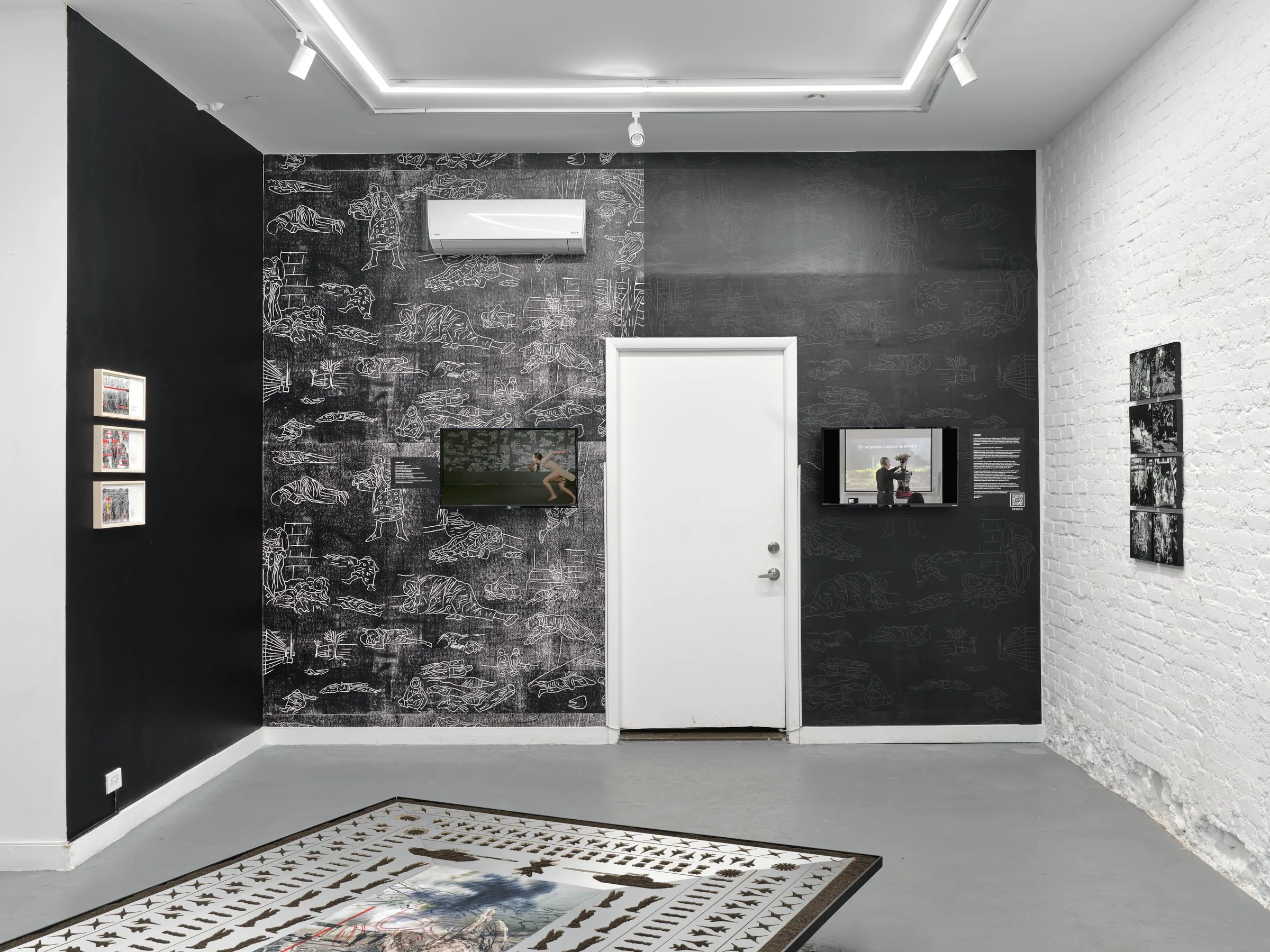
Image courtesy of Trotter & Sholer
Hekler is honored to participate in a survey exhibition You are in the war zone of Farideh Sakhaeifar presented by KODA and Trotter & Sholer addressing the impact of war and the repercussions of displacement. This exhibition includes a video compilation of the collaborative Medium programming War, Memory, Protest; Clear-Hold-Build; and A People’s Tribunal: 28 Exhibits prepared by Jelena Prljević, Joshua Nierodzinski and Nataša Prljević.
Sakhaeifar is an artist and educator who employs a range of media to critique US foreign policy and the Western narrative of the war in the Middle East and Northern Africa (MENA) region. Her creative practice includes sculpture, video, installation, collage, and collaboration with HEKLER, an artist-run collaborative platform fostering the critical examination of hospitality and conflict. This exhibition derives its title from, You are in the war zone (2016-2017), a series of Sakhaeifar’s silver gelatin prints of NYC’s everyday life overexposed and inscribed with hand-traced drawings from Syria’s civil war. The juxtaposition of who suffers and who benefits from conflict is also on display in Pending (2016), a series of digital interventions on photographs of Syrian refugees at the borders of Turkey and Iraq sourced from The New York Times, Getty, and Reuters reports. The bodies of the refugees have been erased leaving only the objects that they carry to represent the violence and trauma experienced during their journey. Toppled (2015) is a bronze statue of a faceless dictator with a rope around its neck in the moment before an act of iconoclasm. The absence of any references to a specific oppressed people allows the sculpture to stand for the collective memory of all rage and victory that gathers at the base of fallen monuments. When pulling down a statue, a chain works better than a rope (2021) is a digital collage of defaced and destroyed statues around the world. The palimpsest of archival photography commemorates the collective “vandalism” done in solidarity and the pursuit of inclusion. Acquired from the above by the present owner (2014) focuses on the [invisible] war and US sanctions imposed on Iran. In this documentary project, Sakhaeifar interviews people who have acquired US army gear from Tehran’s black market. The testimonies investigate the reasons behind purchasing and collecting the gear that is presented in wooden coffins, their portraits being drawn through the collection of objects they possessed.
KODA catalogue text by Nataša Prljević below:
How’s life?
That’s what she always asks me. I hesitate. Then say something short. It’s going...
As the words leave my mouth, I am recalibrating. I have developed a psychological reflex to the Americanized version of a similar question, How are you?, that is all too often disingenuous. But there is no need for defenses here, and joy bursts through into a radical embrace of a familiar voice. We confess for hours, recognizing that our time together is a fleeting chance to fuse parts of a fragmented world. We compare and critique the violent ideological shifts in our regions, the Middle East and what used to be Yugoslavia, the realities and representations of their dissolution. We are compelled to examine the sources, mutations, and consequences of ongoing conflicts, ways our people resist and how our diasporic positions weave into larger resistance movements. How economic devastation and humiliation have affected our ability, and that of our people, to speak truth to power.
We are told that we live in unprecedented times through which we sail in the same boat towards the future of greater togetherness. In actuality, we are complicit in an accelerated racist extractivist system perpetuated by denial and escapism that lies at the core of American and European exceptionalism. As immigrants from societies that have been obliterated by the corruption of domestic elites and U.S. imperialism, we are forced into maintaining the exploitative falsehood of the American Dream. Traumatized, angry, and grieving, immigrants who fled war-torn countries are forced into yet another role: to teach the history of America’s global conquest and commodification. Honest public discourse about U.S. foreign policy and reparations for the invasion of the Middle East don’t exist, even as similar militarized tactics are being employed domestically against economically and racially targeted communities. In response to this void, radical spaces proliferate and amplify narratives made invisible, centering education and action towards social justice.
You are in the war zone is an invitation to emotionally and critically understand that fixed linear time does not exist in conflict, nor in life. War is not an event that belongs to the past. Farideh Sakhaeifar guides us through catastrophe by centering the body and asks us to acknowledge our intertwined histories. How have we grown to normalize dispossession, cultural erasure, and the disposability of people from the Middle East? Dehumanized Iraqi mothers, Syrian children, Afghan men, and Palestinians suffering under Israeli apartheid. An encounter with the cruelty of an image is a potential reckoning. It holds the promise of societal transformation through the commoning of pain and fear. Farideh uses art to connect with personal narratives and experiences of those in pain as an act of reunion and recognition. She unites disparate geographies through a range of media, bringing us to the sites, streets, homes, and hands that hurt and rise in liberation movements. This is where art manifests its pedagogical, political, and transformative power. It teaches us that freedom is not only an individual but a collective right.
Collaboration is just as integral to the artistic process as it is for social movement.
It is present in conceiving, decision-making, and sustaining an artistic practice as well as continuously sharing resources. Farideh exemplifies this because many of her projects have been developed with friends and family. However, it is more common, and often by design, that an artist’s career invisibilizes the labor and support that make their work possible. This erasure is driven by the false concept of a singular genius, a concept amplified to further catalyze capitalist cultural institutions. The merging of art market logic and academia has helped normalize the exclusivity of higher art education. Aspiration towards upward mobility and participation in the classist art system often removes artists from their communities, especially the working class. They teach us that an artist with a daily job is not a professional artist, but merely a hobbyist, perpetuating and normalizing the professionalization of art and social segregation of artists. These institutions want us to believe that artistic existence is unsustainable without their support or, more precisely, submission to their politics, even when those politics claim to be progressive. When an individual artist is invited to subvert dominant narratives and power structures from within an institution, the desired result is really an aestheticization of politics and non-disruptive symbolic representation. Meanwhile, collective action by artists and community organizers to do the same has produced amazing results, including the removal of criminal board members from the same institutions and focused pressure for accountability.
In an effort to merge artistic, pedagogical, and organizing strategies, HEKLER was initiated as a collaborative platform for a transnational community to foster friendships while critically examining hospitality and conflict. With artists Joshua Nierodzinski and Jelena Prljević as co-initiators, the first gathering that was organized with Farideh was HEKLER Medium: War, Memory, Protest. It was hosted by an independent community art space De-Construkt [projekts] in Red Hook. We discussed the relationships among the economy of war, urbanism, and visual culture in Palestine, Iran, and the United States with artworks by Bisan Abu Eisheh, Saba Alizadeh, Sahar Sephadari, and Mandana Mansouri as a point of departure and return. This was our attempt to extend the conversation beyond an art object into the discursive and communal. Farideh and her partner, Sadra Shahab, prepared the traditional Iranian dish ghormeh sabzi. Together they warmly invited politics to the table, where Manijeh Nasrabadi and Zahra Ali moderated a conversation among the guests. This event laid the foundation for future friendships and collaborations.
The documentation that HEKLER is presenting in this exhibition, You are in the war zone, comes from Clear-Hold-Build, a group exhibition, hosted by Twelve Gates Arts in Philadelphia, that was based on Shimrit Lee’s research examining the commodification and lasting trauma of global counterinsurgency. Clear-Hold-Build was an opportunity to bring together practices that exist at the intersection of art and social justice in the political climate of occupied territories and war-torn societies. The participating artists Bisan Abu-Eisheh, Dena Al-Adeeb, Shabir Ahmed Baloch, Samia Henni, Khaled Jarrar, Vladimir Miladinović, The Propeller Group, Farideh Sakhaeifar, and Hồng-Ân Trương—employed investigative methodologies through a range of artistic practices to spotlight the violation of human rights by corporate militarized capitalism in Algeria, Iraq, Pakistan, Palestine, Syria, Vietnam, and Yugoslavia.
To further bring these narratives to life, we invited one of the exhibiting artists, now HEKLER member Dena Al-Adeeb, to join us in conceiving a closing gathering. We wondered how the intersection of communal, artistic, and discursive aspects of HEKLER Medium: War, Memory, Protest and Taste of Displacement, Dena’s featured performance and video work, would unfold in the context of Clear-Hold-Build. In the course of several group conversations, we discussed counter-archival practices as well as our positionalities and poetics within antiwar work. We decided to form A People’s Tribunal: 28 Exhibits, having in mind The People's Tribunal on the Iraq War by the initiative CODEPINK. For this performative tribunal, we invited friends and acquaintances as witnesses: Amina Ahmed, Fadaa Ali, Yaroub Al-Obaidi, Nada El-Kouny, Hatif Farhan, Kazem Ghouchani, Maryam Jahanbin, Luma Jasim, Mohammed Okab, and Hussein Smko, each unraveling a personal and collective experience of the war. We asked each of them to respond to 28 Articles, a 2006 paper written by Australian strategist David Kilcullen that was used to advise General David Petraeus, who helped design the Iraq War troop surge. Witnesses picked the medium of their choice. The result was a communal poetic space of restitution, in which storytelling, installation, dance, and song provided “evidence” to counter the rhetoric that has fueled the U.S. War in Iraq.
As the world feels increasingly fragile, diasporic intimacy and spaces of refuge are necessary compasses. It is only with love and polyvocality in our hearts that we can radically imagine life-centering infrastructures. We persist in assembling, resisting, and learning how to use crises like a portal, as Arundhati Roy thoughtfully observed. Artists, educators, and storytellers, like Farideh, are an integral part of the movement towards one another—towards unity and hope that we might still have time to shed the predatory skin of our world.